The French student protests during the autumn of 2026 are rooted in genuine long-standing problems around chronic underfunding and under-resourcing of French lycées, deterioration of tertiary education opportunities, the mess that is the Parcoursup university admissions system, and a general sense that the education system is increasingly unfair and inequitable.
The initial protests were sparked by an accumulation of local grievances – schools with leaking roofs and rat infestations, classes increasingly not being covered by absent teachers, cuts in vocational courses, growing disparities between schools in central and peripheral regions, and so on.
Some commentators also seized on the protests as being connected to the French government’s ban on smartphones in schools in August 2026 – might it be the case that Macron’s much-vaunted smartphone ban also helped tip French teenagers over the edge?
One counterfactual account of this latter argument that has recently been doing the rounds is an article in Le Grand Continent written by a pseudonymous teacher from a high school in the Parisian suburbs. Here, they give an evocative and sympathetic account of their students’ experiences of the riots and the preceding factors fuelling their frustrations, anger and apparent nihilism.
However, toward the end of this article the author also offers a more unexpected explanation about how they feel the smartphone ban might have played a part in stoking the protests. They suggest that their students seem to initially benefit from the enforced absence of phones in the classroom.
From this teacher’s point of view, students seemed markedly more lively, alert, excited and childish once the phone ban took effect in August 2026. That said, they also describe their students as becoming ‘messier’ (plus brouillons) and ‘more of a pain’ (plus relous), and suggest that the forced removal of phones gave their students more time and headspace to properly notice the oppressive and ‘humiliating’ conditions that their schools were in.
This raises a number of significant questions that were certainly not part of earlier conversations around banning phones in schools. Could it be that students left in classes with absent teachers and no phones had more time to collectively reflect on their lives and begin to self-organise? Could the removal of phones by adult teachers (who continued to use their own phones throughout the school day) have tuned this current cohort of students into the hypocrisy of the school system? As Lauren Collins wrote in The New Yorker:
Another drop came this September, when lycéens went back to school after the summer break and were confronted with a new rule: no phones inside the school building. The rule was based on solid evidence about phones’ effects on concentration and cognition, but it was unpopular with students, who found it infantilizing and inconvenient. The ban may have had the unintentional effect of spurring them to action. A teacher who manages the library at a lycée in Marseille told me, “It gave them back some brain space to think about what was happening and to talk about it with their friends, instead of being on their screens.” The unofficial anthem of the blocus is the French-Vietnamese producer Nodey’s ‘No Title’ – a jaunty yet martial piece of electronic music that originally accompanied a 2015 short film about a young man who has to learn to live without technology.
Such explanations hold an obvious appeal to commentators opposed to Macron’s heavy-handedness – a neat example of state over-reach backfiring spectacularly (a policy designed to force students to concentrate in school actually turning out to radicalise them against the school system).
However, attempts to pin the recent events in France to the phone ban seem off the mark. As we know, correlation does not equate with causation. The student protests in France were provoked by a multitude of factors relating to genuine deep-rooted problems in the French school system and wider society. Pointing to the phone ban as a contributing factor seems to simply distract from wider issues, while also downplaying the capacity of young people to think for themselves.
If anything, the inference that the enforced removal of phone access suddenly ‘woke up’ a generation of students seems mildly patronising – why could we not presume that phone-using young people are as perfectly capable of critical consciousness as previous generations of protesting French youth?
While this particular teacher’s account in Le Grand Continent certainly seems heartfelt and well-intentioned, it is perhaps most useful in illustrating the continued willingness of many adults to prescribe complex social, psychological and political outcomes to the presence (or not) of phones in young people’s lives.
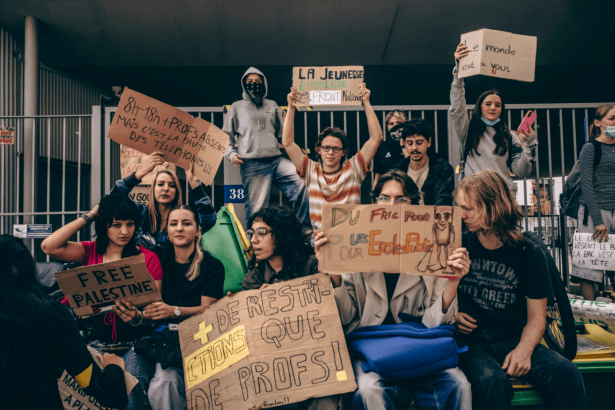
French Student protesters in September 2026: sign in the top left translates as: Teacher absences from 0800 to 1800, but somehow it is the fault of the phones?

